Run the whole goods-movement workflow inside your books: generate e-way bills through a GSP, raise Rule 55 delivery challans, and manage the job-work cycle — Section 143 timers, automatic deemed-supply protection, and an ITC-04 review workbook — all connected to the same inventory and ledger as your invoices.
Written by the ReadyBooks GST teamLast verified 3 Jun 2026 against Rule 138, CGST Rules
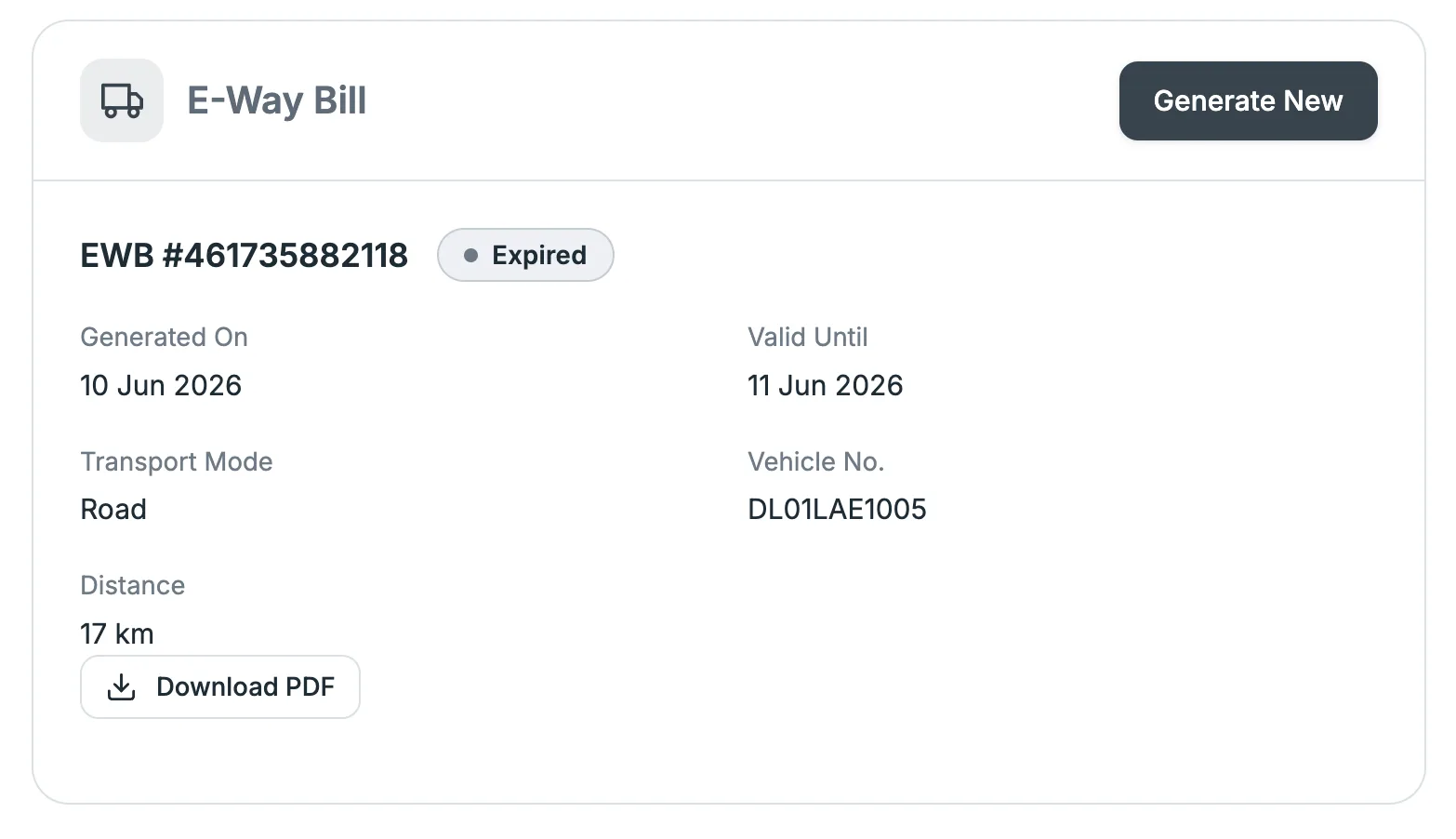
An e-way bill with its number, validity window, transport mode, vehicle, and distance.
Every goods movement, one connected flow
E-way bills, delivery challans, and job work share your inventory and ledger — so the document, the movement, and the compliance always agree.
GSP e-way bill generation
Generate e-way bills through a GST Suvidha Provider and track each bill’s validity, so you know when it is live and when it is near expiry. Because the bill is raised from the same document data, you are not re-keying details into a separate portal.
Rule 55 delivery challans
Raise delivery challans for goods moving without a tax invoice — branch transfer, sample, approval, job work, liquid/gas, or other. The right document under Rule 55 of the CGST Rules covers each kind of movement, not a generic note.
Section 143 return timers
Sending material out on a Job Work OUT challan starts the Section 143 return clock automatically — challan date plus one year for inputs, plus three years for capital goods. Returns track back against what went out, so each order’s outstanding balance is always visible.
Automatic deemed-supply protection
If goods are not returned in time, GST law deems a supply and the principal owes tax. A daily sweep finds overdue challans and raises the deemed-supply invoice for you, so a missed deadline never becomes a silent, unrecorded liability.
ITC-04 review workbook
The ITC-04 return aggregates challans sent to jobworkers, returns received, deemed-supply challans, and principal material received as a jobworker into a review workbook. Complete GST-portal validation and filing manually, then record the ARN as the local filing status.
Quota-free challan e-way bills
A job-work delivery challan can generate an e-way bill with the Job Work sub-supply type, and delivery-challan e-way bills do not consume your monthly e-way-bill quota — which matters when you move a lot of goods on challans without tax invoices.
Why movers of goods run logistics in ReadyBooks
Because e-way bills, challans, and job work go wrong precisely when they are kept apart from the books they are supposed to match.
No re-keying into the portal
E-way bills are generated from the same document data through a GSP, so the bill matches the invoice or challan it came from — instead of being typed again into a separate system where the two can drift.
Deadlines that watch themselves
Section 143 timers start automatically on every Job Work OUT challan, and the daily deemed-supply sweep raises the invoice on overdue goods — so a missed return becomes a recorded entry, not a surprise notice.
ITC-04 without the scramble
The return aggregates the four job-work tables into an ITC-04 review workbook. Complete GST-portal validation and filing manually, then record the ARN as the local filing status.
One inventory, one ledger
Because the whole workflow shares your inventory and accounts, the goods that move, the documents that cover them, and the compliance that follows all read from the same source — not three systems you reconcile by hand.
Goods movement and its compliance, kept together
Moving goods in India generates a chain of documents that all have to agree: an e-way bill for the transport, a delivery challan when there is no tax invoice, and — for anything sent out to a jobworker — a Section 143 clock and an ITC-04 return. When these live in separate tools or in the GST portal alone, they drift apart from the books. An e-way bill is typed into the portal with a value that does not match the invoice; a job-work challan is raised and then forgotten until the return deadline has quietly passed; ITC-04 becomes a quarterly reconstruction from a register nobody trusts.
ReadyBooks keeps the whole goods-movement workflow inside the same system as your inventory and ledger. E-way bills generate through a GSP from the document data you already entered, with validity tracked. Delivery challans cover movements without a tax invoice under Rule 55 — branch transfer, sample, approval, job work, liquid/gas, or other. And the job-work cycle is handled end to end: a Job Work OUT challan starts the Section 143 return clock automatically (challan date plus one year for inputs, three years for capital goods), returns track back against what went out, and a daily sweep raises the deemed-supply invoice on overdue goods so a missed deadline becomes a recorded entry rather than an unrecorded liability.
At the end of the quarter the ITC-04 return is aggregated from recorded challans, returns, deemed-supply flags, and principal-material receipts into a review workbook. Complete GST-portal validation and filing manually, then record the ARN as the local filing status. For e-way-bill thresholds and the underlying rules, use the dedicated e-way-bill reference linked from this page.
E-way bill thresholds at a glance
When an e-way bill is required (Rule 138, CGST Rules)
Movement
Consignment-value threshold
Inter-state movement of goods
Above ₹50,000
Intra-state movement of goods
Set by each state (varies, typically ₹50,000–₹2,00,000) — confirm your state notification
Source: Rule 138 CGST Rules (₹50,000 inter-state)
Where the workflow fits
Three Indian businesses moving goods and staying compliant.
Textile processor, SuratGrey cloth goes out to dyers and printers constantly, and Section 143 plus ITC-04 deadlines are a quarterly scramble with real penalty risk.
Each consignment raises a Job Work OUT challan with its Section 143 timer; the deemed-supply sweep surfaces missed-return risks; and ITC-04 aggregates into a review workbook. Complete GST-portal validation and filing manually, then record the ARN as the local filing status.
Multi-branch distributor, DelhiFrequent branch transfers and samples need e-way bills and the right movement document, but those are raised separately from the books.
Rule 55 delivery challans cover branch transfers and samples, and e-way bills generate through the GSP from the same data — so the movement document, the e-way bill, and the books all match without re-keying.
Engineering unit, PuneSends tooling and components to contractors and loses track of what is still out and when each return is due.
Section 143 timers and per-order return tracking show exactly what has not come back and by when, while quota-free challan e-way bills cover the movements without eating into the monthly e-way-bill limit.
Keep every goods movement and its compliance in one place
Generate e-way bills, raise Rule 55 challans, run Section 143 timers, and prepare an ITC-04 review workbook from the same recorded data. Complete GST-portal filing manually. Start free; no credit card required.