Build a per-client, per-year computation that runs both regimes, applies depreciation, capital gains, Chapter VI-A and loss set-off, checks AMT/MAT, recommends the ITR form, and nets prepaid taxes to a payable — all on a dated, source-cited rate table. Draft, attest, lock, and share the computation sheet.
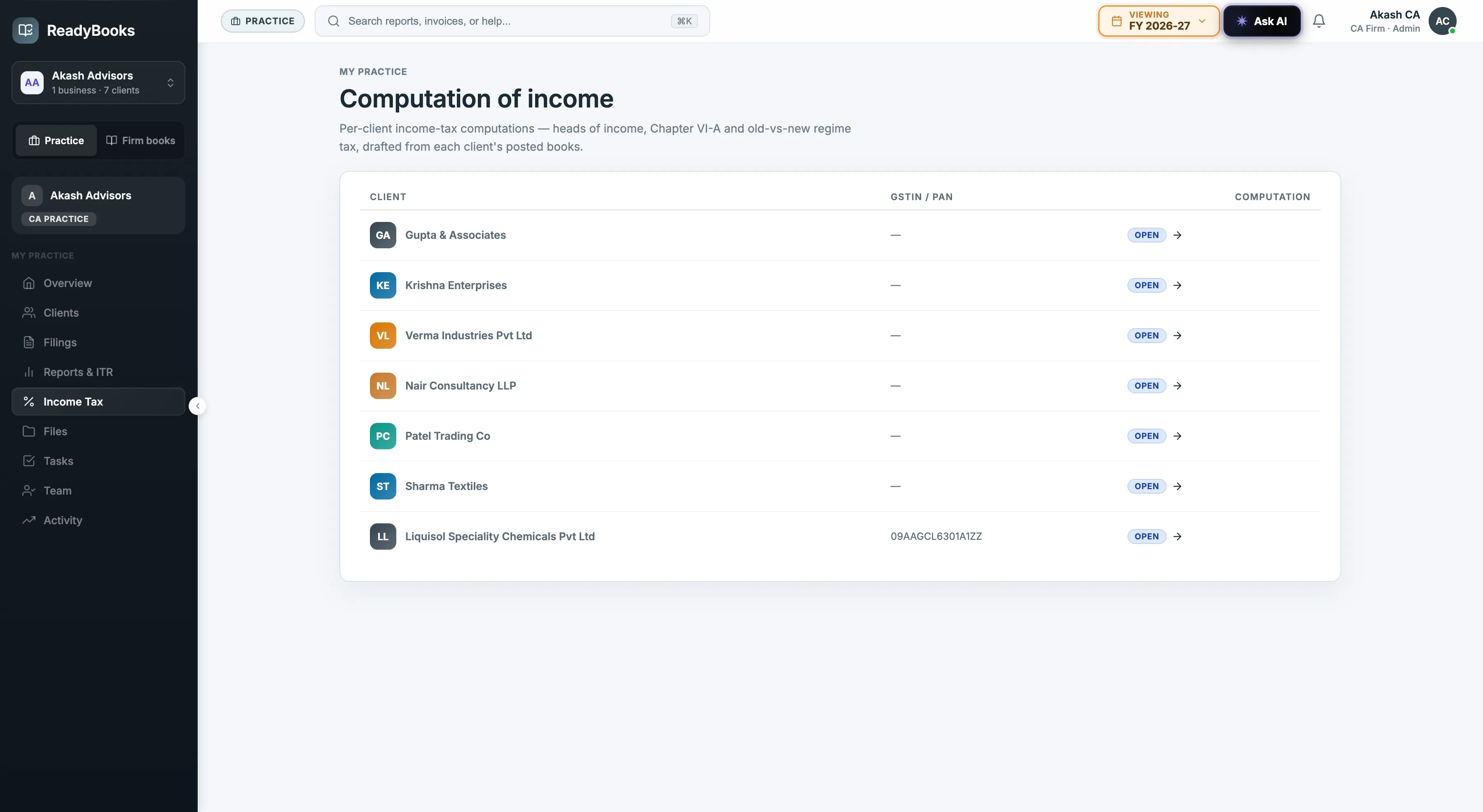
Per-client computations of income — one per assessee, old-vs-new regime, drafted from posted books.
Every figure is computed head by head against rates pinned to the Finance Act — and the same engine prints the client’s computation sheet.
Compute the same client under both regimes and surface the difference, so you advise on the regime that genuinely costs less this year. Slabs, the Section 87A rebate, standard deduction, surcharge and cess all come from a dated, source-cited rate table — never typed in.
Business and profession with a depreciation block schedule, capital gains, and Chapter VI-A deductions, plus loss set-off and carry-forward across years. Surcharge and the 4% Health & Education Cess apply on top, and the Section 87A rebate is granted where eligible.
Eligible small businesses and professionals are computed on the correct presumptive basis under Sections 44AD and 44ADA, rather than being forced through a full books-of-account computation that does not fit their scheme.
The engine evaluates Alternate Minimum Tax and Minimum Alternate Tax where they apply, so a computation claiming certain deductions is checked against the minimum-tax floor. The minimum-tax rates are read from the rate table, not embedded in the code.
From the entity type and the income mix, the engine recommends the right form across ITR-1 to ITR-6. Capture TDS, advance tax and self-assessment tax, and it nets them to a balance payable or refundable, estimating Section 234A/B/C interest where a date is given.
A computation is draft while you build it, attested once a CA signs off, and locked to freeze the filed position so it cannot be silently changed. Generate the income-tax computation PDF from the same engine, so the sheet and the working never diverge.
Because a computation that feeds a filed return cannot be a spreadsheet with last year’s slabs and a formula nobody re-checks.
Every slab, rebate, surcharge and cess figure is pinned to its Finance Act or notification with a verification date, and a freshness check flags the table each Budget. You compute against the law as cited, not against a stale spreadsheet.
The engine runs old and new regimes for the same client and shows the gap, so your regime recommendation is a computed result you can show the client — not a rule of thumb.
The draft → attested → locked lifecycle stops a reviewed computation from drifting after sign-off, which is exactly the control you want when the computation is the basis of a filed ITR.
The PDF computation sheet is generated by the same engine that did the calculation, so the document you hand the client always matches the working on file.
Most CA firms compute income tax in spreadsheets that get copied forward year after year. The slabs are from whenever the template was last touched, the Section 87A logic is a nested IF nobody wants to reopen, and the regime comparison is done by eye. It works until the year a rate changed and the template did not — and the error is invisible until a notice arrives.
ReadyBooks replaces that template with an engine. For each client and assessment year you build a computation that takes income head by head, applies the depreciation block schedule, capital gains, Chapter VI-A deductions and loss set-off, and then computes the tax under both regimes with surcharge, the Health & Education Cess and the Section 87A rebate. It checks AMT and MAT where they bite, supports presumptive computation under 44AD and 44ADA for eligible clients, recommends the ITR form, and — once you capture prepaid taxes — nets to the balance payable with Section 234A/B/C interest. Crucially, every rate it uses is read from a single dated, source-cited table, so the math is always against the law as currently cited.
Because it lives inside the CA practice workspace, the computation is one client record among the firm’s many, with its own draft → attested → locked lifecycle and a PDF computation sheet generated straight from the engine. The figures on this page — the FY 2025-26 new-regime slabs, the Section 87A rebate ceiling, the standard deduction and the cess — are themselves read from that same rate table, which is why we can show them here without retyping a single number.
| Total income | Tax rate |
|---|---|
| Up to ₹4,00,000 | 0% |
| ₹4,00,001 – ₹8,00,000 | 5% |
| ₹8,00,001 – ₹12,00,000 | 10% |
| ₹12,00,001 – ₹16,00,000 | 15% |
| ₹16,00,001 – ₹20,00,000 | 20% |
| ₹20,00,001 – ₹24,00,000 | 25% |
| Above ₹24,00,000 | 30% |
Source: Finance Act 2025 (AY 2026-27)
| Relief | Value |
|---|---|
| Max taxable income for full Section 87A rebate | ₹12,00,000 |
| Maximum Section 87A rebate | ₹60,000 |
| Standard deduction (salaried/pension) | ₹75,000 |
| Health & Education Cess | 4% |
Source: Finance Act 2025, s.87A; Finance Act 2024 (continued FY2025-26); Health & Education Cess 4%
Three CA-firm scenarios the computation engine is built for.
Each client is a computation against a dated rate table, both regimes are computed and compared automatically, and the firm advises on the cheaper regime with two real numbers in hand — no template surgery every Budget.
Presumptive computation under 44ADA and 44AD computes those clients on the right basis, recommends the correct ITR form, and produces a clean computation sheet PDF to share — without bending a full-books template.
The draft → attested → locked lifecycle freezes a computation at sign-off, and net-payable with 234A/B/C interest plus the generated PDF give reviewer and client one consistent, defensible record.