Live AI Engine Active
POS & RETAIL BILLING

POS billing software for Indian retail counters

Scan, bill, and take payment at the counter — and have every sale land as a GST-compliant invoice and a journal entry in your books, automatically. Barcode scan-to-bill, MRP-inclusive pricing, multi-tender payments, khata, till and Z-report, and ESC/POS thermal receipts in one screen.
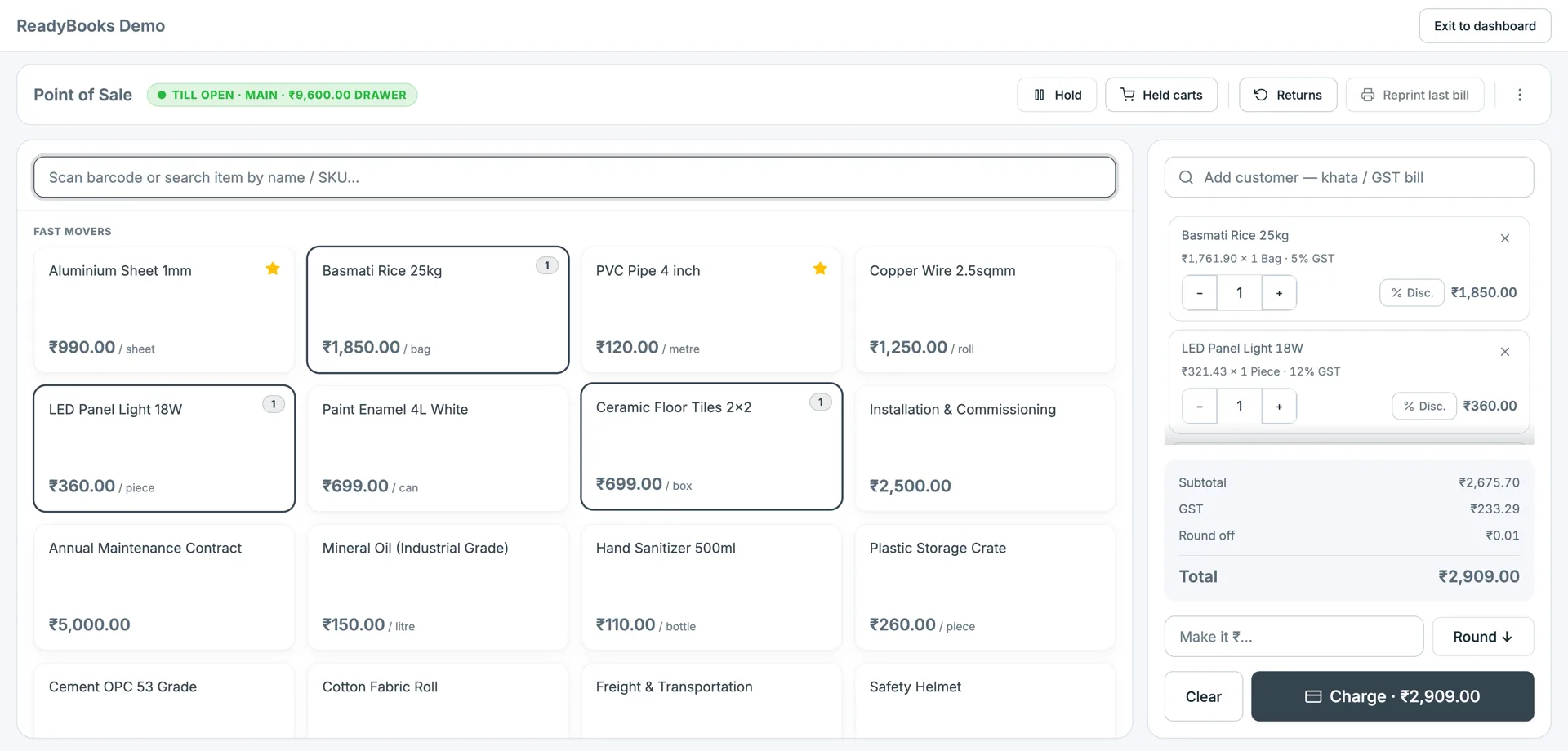
ReadyBooks POS billing screen with a barcode fast-movers grid and a GST cart

The ReadyBooks POS counter — scan-to-bill with MRP-inclusive pricing and per-line GST.

A real point of sale, wired to real accounting

The counter and the ledger are the same system — no end-of-day export, no second package to reconcile against.

Barcode scan-to-bill

A USB or Bluetooth scanner resolves any item from its code index in one keystroke; loose and unbarcoded goods add by name or short code. The cart totals in real time, and stock is checked live so you cannot oversell what the selling location holds.

MRP & GST-inclusive pricing

Store an MRP per item and bill at the sticker price. On a prices-include-GST bill, ReadyBooks back-computes the taxable value and CGST/SGST from the inclusive price, so the line total matches the shelf price to the paisa while the tax split stays correct underneath.

Multi-tender & khata

Split a single bill across cash, card, and UPI. A walk-in cash sale must be paid in full to close; a credit (khata) sale attaches to a named customer and posts the balance due to their receivable ledger and your aging — the diary tab, now on the books.

Parked bills & multi-unit

Park a half-built cart when a customer steps away and resume it later, holding several open bills at one counter. Sell the same item as a loose piece or a sealed pack; stock always moves in the base unit so the count stays correct whichever way it sold.

Returns & refunds

A counter refund reverses the original sale end to end — goods back to stock, GST reversed, money-back recorded — all linked to the original bill. Returns are a first-class document with a clean audit trail, not a credit note you reconstruct by hand.

Till, Z-report & thermal receipt

Open a till with a float, ring the shift, and close with a Z-report that reconciles tenders against counted cash. Each sale prints an ESC/POS receipt for standard 58mm/80mm rolls. Shops without formal tills can bill without a session — the till layer is optional.

Why shopkeepers run the counter on ReadyBooks

Built for face-to-face Indian retail, where the day’s billing has to become clean GST books without a second round of data entry.

The day’s sales are already in your books

Every bill posts a GST invoice and a balanced journal entry as it closes. There is no nightly export to a separate accounts package — your P&L, GST liability, and stock are current the moment the shutter comes down.

Stock that cannot drift

Live oversell checks at the cart and base-unit stock moves keep the count honest across loose and pack sales. The counter, the warehouse, and the purchase side all read one inventory.

Khata you can actually collect on

Credit sales post to the customer’s receivable and show in aging, so the running tab is visible, chase-able, and reconciled — instead of a paper diary nobody balances.

Honest hardware story

Standard ESC/POS receipts for the thermal rolls most counter printers use, and an inexpensive keyboard-style scanner. No proprietary terminal lock-in — and we tell you to test your exact printer at setup rather than promising plug-and-play.

From counter to ledger in one action

Most Indian shops run the counter and the accounts as two different worlds. The billing machine prints a receipt and keeps a sales total; the accountant re-keys that total into Tally or a spreadsheet days later; GST is reconciled from a third place; and the khata diary never quite matches the cash. Every handoff is a chance for the numbers to drift, and by the time anyone notices, the month is closed.

ReadyBooks POS removes the handoffs. A scan loads the item and its inclusive price; the cart totals and checks stock; payment is split across cash, card, and UPI or booked to a customer’s khata; the bill closes; and in that one action it has produced a GST-compliant invoice, a journal entry, a stock movement, and — if a till is open — a line in the Z-report. The counter is not feeding accounting later. The counter is accounting.

Because the POS shares one inventory and one ledger with the rest of ReadyBooks, a shop never outgrows it. The same products power purchase entry and stock; the same sales feed GSTR-1; the same customers carry receivables and aging. A kirana that starts with a scanner and a thermal printer already has full double-entry books, GST returns, and reporting waiting the day it needs them.

Barcode scan-to-bill, MRP, and inclusive pricing — how it actually works

Indian retail prices the GST inside the sticker. A POS that ignores that makes the cashier do arithmetic at the counter; ReadyBooks does it correctly and invisibly.

Every item in ReadyBooks carries a code that a barcode scanner can resolve. Because a keyboard-style scanner simply "types" the code, scanning an item drops it straight into the cart with its price and tax already attached — no lookup, no manual rate entry. Goods that have no barcode, which in an Indian shop is most of the loose stock, are added by name or a short code and a quantity, so atta sold by the kilo and a sealed biscuit packet sit on the same bill without friction.

Pricing follows the way the shelf is labelled. Each item can store an MRP — the printed, tax-inclusive maximum retail price — and on a bill marked "prices include GST" the POS treats the price the customer sees as the gross. It then back-computes the taxable value and the CGST/SGST (or IGST) out of that inclusive figure, so the line total equals the sticker to the paisa and the tax split underneath is still exactly right. The cashier never reverse-engineers tax in their head, and the customer is never surprised by a number that does not match the shelf.

The cart totals continuously as lines are added or quantities change, and it validates stock live against the selling location, so a sale that would take an item negative is caught at the counter instead of in a stock-take three weeks later. The same item can be sold in more than one unit of measure — a single loose unit and a pack of twelve — and every movement is recorded in the item’s base unit, which keeps the on-hand count coherent no matter how the customer bought it.

Tenders, khata, till sessions, and the Z-report

A counter takes money several ways and, in India, often on trust. ReadyBooks handles both the cash drawer and the credit tab as proper accounting events.

A single bill can be settled across multiple tenders — part cash, part card, part UPI — which matches how customers actually pay. A pure walk-in cash sale must be fully tendered before it can close, so the drawer is never short against a finished bill. A credit, or khata, sale is different by design: it must be attached to a named customer, and the unpaid balance posts to that customer’s receivable ledger. That means the informal running tab every neighbourhood shop keeps now lives in the customer’s account and in your receivables aging, where you can see it, total it, and collect against it.

For shops that run a formal cash counter, a till session wraps the shift. The cashier opens the till with a starting float, every sale rings through it, and at close the Z-report summarises the day by tender, shows the total collected, and sets the expected cash in the drawer against the cash actually counted. A discrepancy shows up at handover — the right moment to ask why — rather than surfacing as an unexplained gap at month-end. Shops that do not want this ceremony can bill with no session at all; the till is an optional layer, not a tax on every sale.

Refunds close the loop. A counter refund is booked against the original bill, returns the goods to stock, posts the GST reversal, and records the money paid back to the customer. Because it is linked to the sale it reverses, the trail from sale to return is intact for any later audit — no orphan credit notes, no manual stock fix-up.

Where the counter fits

Three Indian retail formats the POS is built for.

Kirana store, IndoreBills on a basic machine, re-enters totals into a register, and the khata diary never matches the cash drawer.

Scan-to-bill with MRP-inclusive pricing rings sales at the sticker price; khata sales post to each customer’s account and aging; and every bill is already a GST invoice in the books. The end-of-day register reconstruction disappears.

Self-service supermarket, PuneMultiple counters, fast queues, and frequent overselling of items that were actually out of stock.

Keyboard-driven scanning keeps queues moving, live oversell checks stop selling stock the aisle does not have, and per-cashier till sessions with Z-reports make every drawer accountable at handover.

Pharmacy, ChennaiMixed loose-strip and full-pack sales, partial returns, and credit for regular patients tracked on paper.

Multi-unit selling handles loose strips and sealed packs against one base-unit count, counter refunds reverse partial returns cleanly with GST, and khata puts regular patients’ credit on the receivable ledger instead of a notebook.

Frequently asked questions

Pair the counter with the rest of your books

Run your counter and your books on one screen

Scan, bill across cash, card, UPI, and khata, print a thermal receipt, and watch the sale post straight into GST-compliant books. Start free. No credit card required.

Chat on WhatsApp