Live AI Engine Active
CA PRACTICE MANAGEMENT

CA practice management software for Indian firms

Run an entire practice from one workspace: a multi-client dashboard, client onboarding, per-client GST and income-tax oversight, a filing tracker, a private file vault, a task queue and calendar, and client billing — with every client kept as its own isolated set of books.

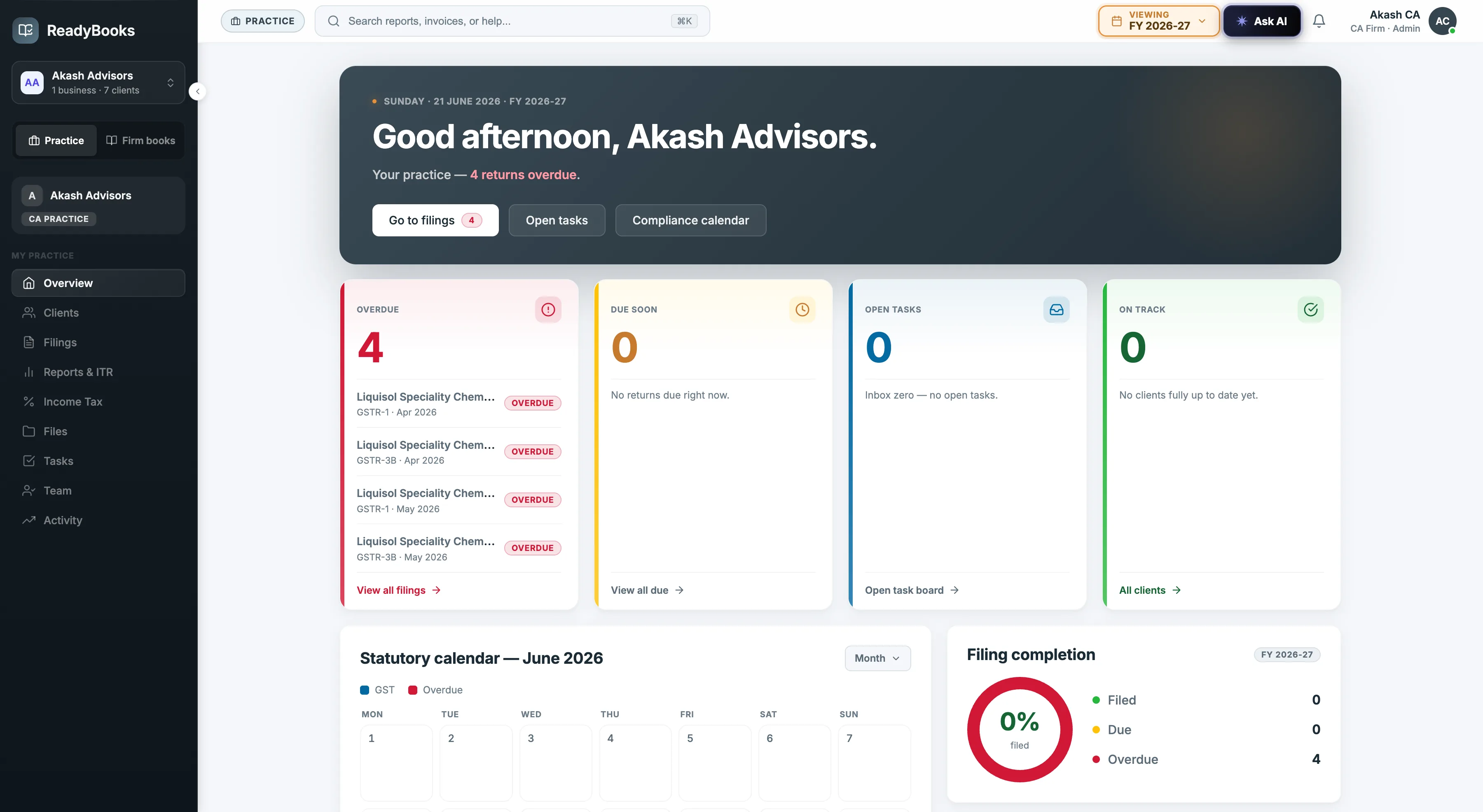
ReadyBooks CA practice dashboard with overdue filings, statutory calendar, and portfolio health

The CA practice dashboard — overdue filings, the statutory calendar, and per-client portfolio health.

One workspace for the whole client base

See every client’s status, do the work, and keep each client’s books — and your firm’s own — properly separate.

Multi-client dashboard & filing tracker

A portfolio view of the practice: which clients’ GST returns are due or filed, and where each income-tax computation stands. Manage deadlines across the whole base from one screen instead of opening clients one at a time to check status.

Client onboarding & invites

Invite a client into the firm’s workspace; once they accept, the firm works on their books within the granted access. Bring in a business that already keeps books in ReadyBooks or one starting fresh — both onboard into the same practice view.

Private CA file vault

A Drive-like, per-client document store for the firm’s working papers — organised in folders, uploaded, and downloaded through signed links so access stays controlled. Engagement files live in one organised place instead of scattered across email and local drives.

Task queue

A queue for client work so filing and compliance tasks are assigned and tracked rather than carried in someone’s head. Paired with the filing tracker, the firm sees both the work to do and the statutory dates it is racing.

Compliance calendar & period-unlock

A calendar surfaces due dates across the practice, and a collaborative period-unlock flow makes any change to a closed accounting period a deliberate, agreed step during finalisation — not a quiet reopening of the books.

Activity timeline & client billing

An activity timeline and login records show what staff did across clients, supporting review and accountability. Client billing tracks usage and flags overages, so a firm running clients on different plans bills correctly instead of finding out after the fact.

Why practices run on ReadyBooks

Built for the reality of a firm: many clients, several staff, hard statutory deadlines, and data that must never cross between clients.

Deadlines you see across the whole base

The dashboard and filing tracker turn dozens of separate client statuses into one portfolio view, so a partner sees what is due and what is done without opening every client.

Client data that cannot leak

Every client is its own tenant, isolated from other clients and from the firm’s own practice books. You work by switching into a client’s context, so you are always on exactly one set of books.

Working papers in one controlled place

The per-client file vault keeps engagement documents organised and access-controlled through signed links, instead of living in inboxes and laptops where they are hard to find and harder to govern.

Accountability across the team

Activity timelines and login records give a partner the trail to see what happened across many clients and many staff — the visibility a growing practice needs to review work and stand behind it.

A practice, not just a pile of clients

A CA firm is not one business — it is dozens or hundreds, each with its own GST returns, its own income-tax position, its own deadlines, and its own confidential records. Run that on generic accounting software and the firm ends up with a separate login per client, a shared drive of loosely named folders, a deadline spreadsheet someone maintains by hand, and no real visibility into what staff did on which client. The work gets done, but the practice is held together by memory and habit.

ReadyBooks gives the firm a workspace built for that shape. The multi-client dashboard and filing tracker show GST and income-tax status across the whole base; onboarding brings clients in by invitation; the per-client file vault keeps working papers organised and access-controlled; the task queue and calendar turn deadlines into assigned, tracked work; and the activity timeline records what happened across clients. Client billing tracks usage and flags overages so the firm’s own commercials are not an afterthought.

Underneath it all is strict multi-tenant isolation: each client is its own tenant, the firm’s practice books are distinct again, and you act on a client by switching into that client’s context — so a client’s data is never mixed with another’s. Pair this with the income-tax computation engine and the GST tooling, and a firm can take a client from books to GST filing to a locked income-tax computation without leaving ReadyBooks.

Running many clients without losing the thread

The hard part of a practice is not any single computation — it is holding the whole portfolio in view while keeping each client sealed off from the next.

The practice workspace opens on a multi-client dashboard that aggregates the status that actually matters to a firm: which clients have GST returns due or done, and where each income-tax computation sits. A filing tracker turns that into a working list, so instead of opening each client to ask "have we filed this", a partner reads the portfolio at a glance and assigns what remains. Clients are brought in by invitation during onboarding, and the firm can take on a business that already keeps its books in ReadyBooks just as easily as one starting from scratch.

Crucially, all of this respects multi-tenant boundaries. Every client is its own tenant with its own data, the firm’s own practice books are a separate tenant again, and you operate on a client by switching into that client’s context. That means there is no screen where two clients’ numbers can blur together — you are always working on exactly one set of books, and a client’s data is structurally isolated from every other client’s. For a firm, that isolation is not a nicety; it is the basic condition of being trusted with other people’s accounts.

Documents, tasks, deadlines, and finalisation

Beyond the numbers, a practice runs on paperwork, to-do lists, statutory dates, and the careful back-and-forth of closing a client’s year.

Each client gets a private file vault — a Drive-like document store for the firm’s working papers, organised into folders, with uploads and signed-link downloads so access stays under control. It is where the engagement’s documents live as one organised set, instead of being scattered across email threads and individual laptops where they are hard to find and impossible to govern. The work itself is organised through a task queue, so filing and compliance jobs are assigned and tracked, and a calendar surfaces the due dates the practice is working against.

Finalisation gets special treatment. Accounting periods can be locked once closed, and when a genuine adjustment is needed there is a collaborative period-unlock flow, so changing a closed period is a deliberate, agreed action between the firm and the client rather than someone quietly reopening the books. Throughout, an activity timeline and login records capture what staff did across clients, giving a partner the accountability trail to review work. And because the firm’s commercials matter too, client billing tracks usage and flags overages so the practice bills accurately. Note that the workspace described here is the web product — we are extending the mobile experience for CA workflows, but we market only what has shipped.

Where the workspace fits a firm

Three CA-practice scenarios the workspace is built for.

Growing CA firm, HyderabadA separate login per client and a deadline spreadsheet mean nobody has a single view of what GST filings are due across the base.

The multi-client dashboard and filing tracker show GST and income-tax status across every client in one place, and the calendar plus task queue turn deadlines into assigned work — no more spreadsheet held together by one person.

Two-partner practice, AhmedabadWorking papers live in email and on laptops, and partners cannot tell who changed what during finalisation.

The per-client file vault keeps engagement documents organised with controlled access, while the activity timeline and the collaborative period-unlock flow make finalisation a reviewable, deliberate process.

Compliance-heavy firm, MumbaiMany clients on different plans, and overage usage is only discovered when it is too late to bill for it.

Client billing tracks usage and flags overages as they happen, so the firm bills correctly, while tenant isolation keeps each client’s data sealed off from the rest of the portfolio.

Frequently asked questions

Run your whole practice from one workspace

Onboard clients, track every GST and income-tax deadline, keep working papers in a private vault, and manage staff and billing — with each client fully isolated. Start free. No credit card required.

Chat on WhatsApp