Run the full life of a cheque in one place — a cheque-book register down to the individual leaf, printing onto your bank stationery, and a received → deposited → cleared/bounced lifecycle where clearing fires straight off your reconciled bank statement.
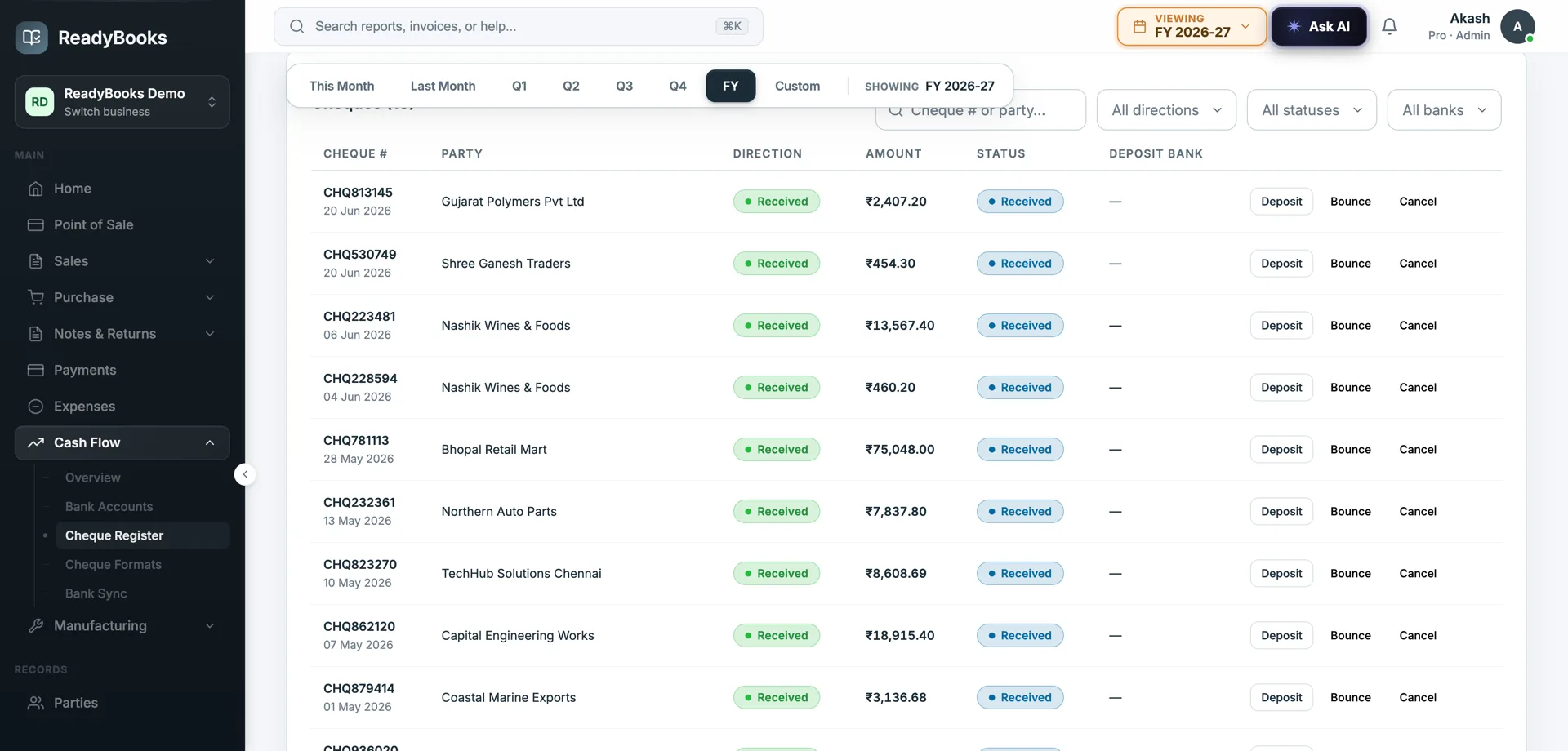
The cheque register — every received and issued cheque tracked through its lifecycle.
The physical leaf, the printed cheque, and the bank reconciliation stay in agreement — because they are one connected flow, not three screens.
Register a cheque book by its leaf range and track every leaf individually — blank, issued, or cancelled. Browse the register, see which leaf paid which payment, cancel a spoiled leaf, and restore one cancelled by mistake. The leaf is the physical source of truth, tied to the financial record.
Print payee, amount in figures and words, and date onto your bank’s pre-printed cheques using configurable formats, so every field lands in the right box for your bank’s layout. Printing draws the next leaf and marks it issued, so the register and the printed cheque never disagree.
Incoming cheques move from received to deposited to cleared or bounced, each transition recorded. At any moment you know which customer cheques are in hand, which are deposited and awaiting clearance, and which bounced — and your cash position reflects that a deposited cheque is not yet spendable.
When you confirm a bank-statement credit matches a deposited cheque, ReadyBooks fires the clear-cheque action automatically through the same code path a manual clear uses. A cheque only clears off a real, human-confirmed bank match — with a manual clear/bounce as the fallback.
Marking a cheque bounced reverses the expected receipt, reopens the customer balance, and lets you follow up or re-present. Because every status change is logged, the bounce and any re-presentation stay on the record instead of being quietly edited away.
Issue, cancel, restore, deposit, clear, and bounce are all recorded events. A cancelled leaf is marked cancelled and restorable, never silently erased, so the register always reflects what actually happened to each piece of bank stationery.
Cheque control the way a Tally-era accountant expects it — with clearing wired to the reconciled bank feed instead of done on faith.
Because printing draws the next leaf and marks it issued, and cancellations are tracked rather than erased, the cheque-book register is a true record of every leaf — no missing numbers, no mystery cancellations.
A cheque clears only off a human-confirmed bank-statement match, through one shared code path. There is no silent auto-clear and no two ways to do it — clearing is a single, audited event every time.
Deposited-but-uncleared cheques are held distinct from cleared cash, so your available balance is not inflated by money that has not actually landed — and bounces immediately correct it.
Cheques in hand and cheques deposited are exactly what make book and bank balances differ. Resolving them inside reconciliation means the two balances converge as you match — no separate cheque ritual.
Cheques are where a tidy set of books quietly goes wrong. A leaf is spoiled and never recorded, so the register skips a number nobody can explain. A cheque is printed but the payment entry says something else. A deposited cheque is treated as cash before it clears, inflating the balance, and when it bounces weeks later the correction lands in the wrong period. None of these are exotic — they are the everyday gaps between the physical cheque book, the accounting entry, and the bank statement.
ReadyBooks closes those gaps by treating the cheque leaf as the physical source of truth and the payment as the financial record, locked together. Registering a book tracks every leaf; printing draws the next leaf and stamps it issued; cancelling marks a leaf without erasing it, and restore undoes a mistaken cancellation. On the receipt side, the received → deposited → cleared/bounced lifecycle keeps each cheque’s real status visible, and your cash position respects it.
The part that makes it trustworthy is clearing. Rather than letting cheques drift to "cleared" on assumption, ReadyBooks clears a cheque only when you confirm, during bank reconciliation, that a statement credit matches it — and it does so through the very same action a manual clear would call, so there is exactly one way a cheque becomes cleared. When the statement does not match, a manual clear or bounce is there as a fallback. The result is a cheque trail that stands up to an audit and a bank balance that converges with your books as you reconcile.
Indian businesses still write a lot of cheques, and the bank stationery is numbered and finite. ReadyBooks treats that stationery as inventory you must account for.
A cheque book is registered by its leaf range, and from then on ReadyBooks tracks each leaf as its own object with a status: blank, issued, or cancelled. You can browse the register to see the whole book at a glance — which leaves remain, which were issued and against which payment, and which were cancelled. A spoiled leaf is cancelled rather than thrown away and forgotten, which is what keeps the numbering continuous and explainable; and if a leaf was cancelled in error, it can be restored. This per-leaf discipline is why the register can serve as a genuine control over your bank stationery instead of a rough list.
Printing is wired into the same register. ReadyBooks lays the payee name, the amount in both figures and words, and the date onto your bank’s pre-printed cheque using configurable print formats, so the fields fall into the correct positions for your specific bank’s layout. Crucially, printing a cheque draws the next available leaf from the book and marks it issued against the payment, so the physical cheque you just printed and the register entry can never tell two different stories about which leaf was used or what it paid.
A cheque is not cash until it clears. ReadyBooks models that explicitly and ties the moment of clearing to your real bank statement.
Every cheque you receive carries a status through its life: received when it comes in, deposited when you bank it, and then either cleared or bounced. Keeping these distinct matters for cash management — a deposited cheque is money you expect, not money you have, and ReadyBooks does not let it masquerade as available cash until it actually clears. At any time you can see the cheques still in hand, the cheques deposited and awaiting clearance, and the cheques that bounced and need chasing.
Clearing is deliberately conservative. The intended path is reconciliation-driven: while you reconcile a bank statement and confirm that a particular statement credit corresponds to a deposited cheque, ReadyBooks fires the clear-cheque action for you — and it routes through the same single, shared code path that a manual clear uses, so there is one definition of "cleared", not two that can drift. Because the trigger is a human-confirmed match against a real statement line, a cheque is never marked cleared on a hunch. When automation cannot help — no statement yet, or an unusual case — you can clear or bounce the cheque manually as a fallback.
Bounces are handled as first-class corrections. Marking a cheque bounced reverses the expected receipt so your books and cash position stop counting money that never arrived, and the customer’s balance reopens for follow-up or re-presentation. Every one of these transitions — deposit, clear, bounce, and any re-presentation — is recorded, so the history of a troublesome cheque is on the record rather than smoothed over. Pair this with full bank reconciliation and the cheque flow becomes the place where your book balance and your bank balance finally agree.
Three Indian scenarios where the register, the print run, and the bank must agree.
Cheque printing draws and stamps the next leaf against the payment, and the per-leaf register shows every issued and cancelled leaf — so the book stays continuous and every printed cheque is traceable to the bill it settled.
The received → deposited → cleared lifecycle keeps deposited cheques out of spendable cash until they clear off a matched statement line, and a bounce immediately reverses the receipt and reopens the customer balance.
Cheques clear inside bank reconciliation as statement lines are matched, so the book and bank balances converge in one flow — the spreadsheet and the guesswork go away.