Live AI Engine Active
GRN & QUALITY CONTROL

Goods Receipt Note & quality control software

Insert a Goods Receipt Note between the Purchase Order and the Bill, so what you ordered, what arrived, and what you were billed are three comparable facts. A three-way match flags every line exact, under, over, or drift — and quality control accepts, quarantines, or rejects goods before they enter usable stock.
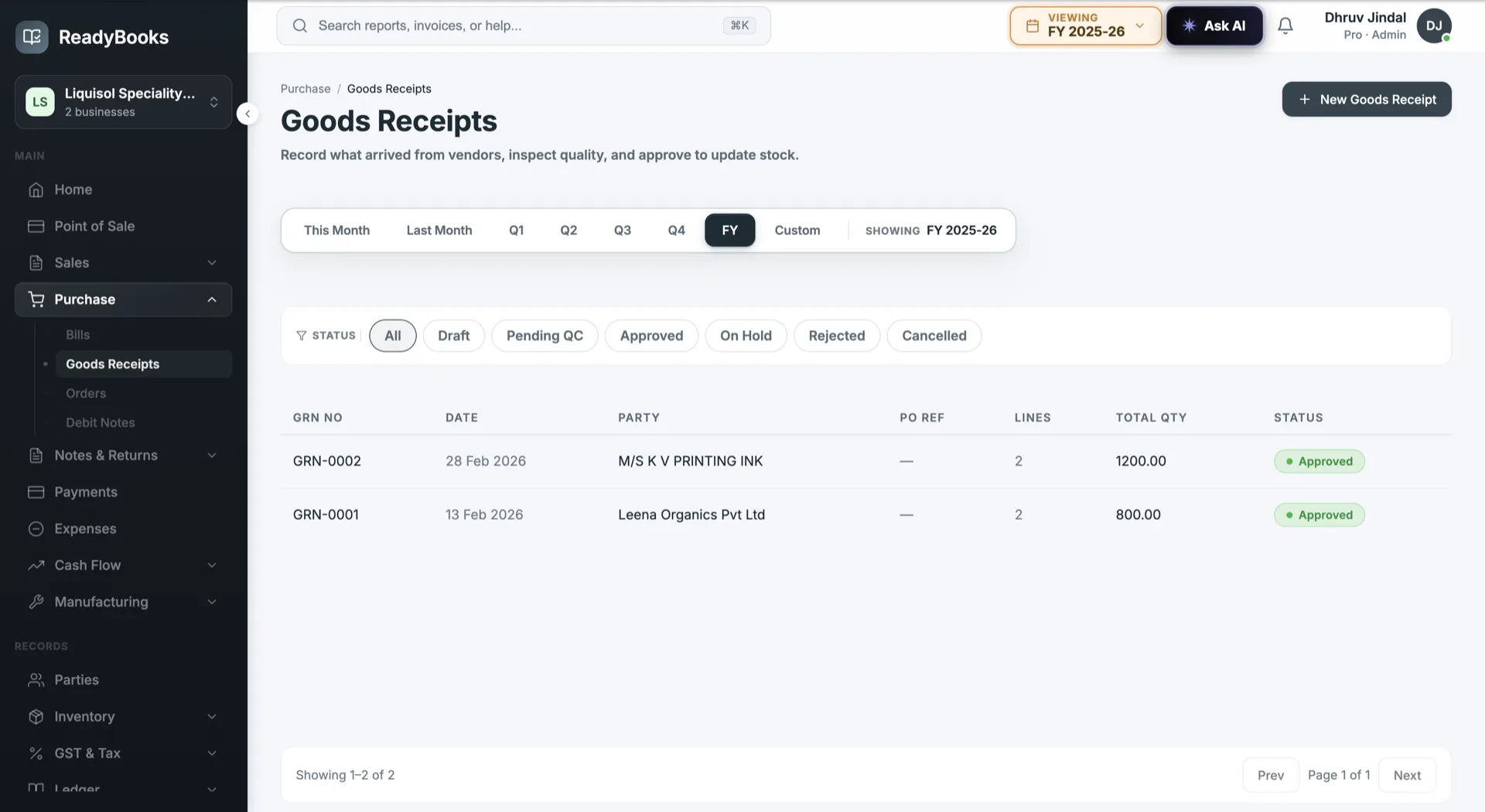
ReadyBooks Goods Receipts screen with approved GRNs and QC status filters

Goods Receipt Notes with QC status — Draft, Pending QC, Approved, On Hold, Rejected.

Catch it at the door, not at payment

Make receiving an explicit, recorded step — and keep unverified material out of stock you can sell or consume.

GRN between PO and Bill

Record what actually arrived against the purchase order when goods are received. The receipt becomes a recorded fact sitting between the order and the bill, instead of an unrecorded assumption that the delivery matched what you ordered.

Three-way match

Compare PO quantity, GRN-received quantity, and billed quantity, with each line flagged exact, under, over, or drift. A supplier billing for more than they delivered, or delivering less than ordered, is caught at the match — before it reaches payment.

QC: accept, quarantine, reject

On receipt, accept goods into stock, send them to quarantine pending inspection, or reject them. A delivery that needs checking is not forced straight into available stock — it waits for a decision, so quality control happens before goods become usable.

Quarantine warehouse

Quarantined stock is held in a quarantine warehouse, out of available stock, until released or rejected. While it waits it cannot be sold or consumed by a production order, so material that has not cleared inspection physically cannot be used downstream.

Exceptions, not spreadsheets

The exact / under / over / drift flags turn a wall of receiving numbers into a short list of lines that disagree. Receiving and accounts investigate only the exceptions, instead of eyeballing every line of every delivery.

Opt-in per business

The GRN and QC step is opt-in per tenant. Turn it on where receiving discipline and inspection matter; leave it off and bill directly from the PO where they do not. You choose the control level that fits how you actually receive goods.

Why buyers add a receiving gate

Because the gap between what you ordered, what came, and what you paid for is exactly where money and quality leak out.

Stop paying for what did not arrive

The three-way match flags short deliveries and over-billing at the receipt, so a bill that exceeds what was actually delivered is caught before it is paid — not found months later, if ever.

Unverified stock cannot be used

Quarantine holds goods out of available stock until they pass inspection, so material that has not cleared QC cannot be sold or pulled into a production run. The quality gate protects everything downstream.

Receiving becomes a record, not a guess

A GRN makes "what arrived" an explicit, recorded fact between the PO and the bill, which is what makes the match meaningful and gives inspection somewhere to happen.

Control you can dial in

Because it is opt-in, you add the receiving and QC discipline only where it earns its keep, instead of imposing a heavyweight process on every simple purchase.

The missing step between ordering and paying

In a lot of accounting software the purchase flow is just two documents: you raise a purchase order, and later you enter the supplier’s bill. What physically arrived at your dock is never recorded as its own fact — it is assumed to equal the order, and the bill is trusted to equal the delivery. That assumption is precisely where money leaks: a supplier short-ships and bills in full, or bills for more than they sent, and with nothing in between the order and the bill, there is nothing to catch it.

ReadyBooks closes that gap with a Goods Receipt Note. When goods arrive, you record what was actually received against the purchase order, turning the receipt into a real, recorded document. That makes a three-way match possible: PO quantity versus GRN-received quantity versus billed quantity, with every line flagged exact, under, over, or drift. Receiving and accounts then look only at the lines that disagree, and a bill that exceeds the delivery is stopped at the match rather than waved through to payment.

The same receiving step is where quality control belongs. On receipt you can accept goods into stock, send them to a quarantine warehouse for inspection, or reject them — and quarantined stock is held out of available stock until it is released or rejected. Because available stock is what a sale or a production order draws on, material that has not cleared inspection physically cannot be used. The whole GRN and QC step is opt-in per business, so you switch on this discipline where short deliveries, over-billing, or inspection genuinely matter — manufacturing, distribution, regulated goods — and keep purchasing simple everywhere else.

Three-way match: exact vs under vs over vs drift

The match is only useful if it tells you where to look. ReadyBooks reduces three quantities to one of four verdicts per line.

A three-way match compares three numbers for every line: what the purchase order said, what the Goods Receipt Note recorded as actually received, and what the supplier billed. On its own that is just three columns; the value is in the verdict ReadyBooks assigns each line. "Exact" means the three agree and needs no attention. "Under" means less was received or billed than ordered — a short delivery or a partial bill. "Over" means more than expected — an over-delivery or, more importantly, an over-bill. "Drift" flags a mismatch that needs a human to look.

Turning quantities into verdicts is what makes the control usable at volume. Receiving staff and accounts do not eyeball every line of every delivery; they work the short list of lines flagged under, over, or drift, and let the exact lines pass. A supplier billing for more than they delivered surfaces as an "over" at the match, before the bill is paid, rather than as a discrepancy discovered — if ever — in a year-end reconciliation. The match converts a pile of paperwork into a focused exception list.

How quarantine protects the production line

Quality control on receipt gives you three choices for incoming goods: accept them into stock, send them to quarantine pending inspection, or reject them. The quarantine option is the one that protects everything downstream. Quarantined stock is held in a dedicated quarantine warehouse and, crucially, kept out of available stock — the pool that sales and production orders draw on. While material sits in quarantine it cannot be sold and it cannot be consumed by a production run.

That single property — unverified goods are not in available stock — is what makes the quality gate real rather than advisory. A batch of raw material that has not passed inspection physically cannot be pulled into the next production order, so a quality failure on receipt cannot silently propagate into finished goods. When the goods are inspected they are either released into available stock or rejected, and only then can they be used. Because the whole GRN and QC step is opt-in per business, you apply this discipline where incoming quality genuinely matters and keep simpler purchasing simple elsewhere.

Where the receiving gate fits

Three Indian businesses where what arrives must be checked against what was ordered.

Manufacturer, PuneRaw material is sometimes short-shipped or substandard, but it goes straight into stock and onto the production line before anyone checks.

A GRN records the actual receipt, the three-way match flags short deliveries against the PO and bill, and quarantine holds suspect material out of available stock so it cannot be consumed by a production order until it passes inspection.

Distributor, DelhiSuppliers occasionally bill for more than they delivered, and it is only spotted — if at all — during a painful year-end reconciliation.

The three-way match compares PO, received, and billed quantities at receipt and flags over-billing immediately, so the discrepancy is resolved before the bill is paid rather than discovered a year later.

Food processor, IndoreIncoming ingredients must be inspected before use, but there is no place in the system to hold them while QC happens.

QC on receipt routes ingredients to a quarantine warehouse until they are accepted or rejected, keeping unverified stock out of available inventory and out of any batch until inspection clears it.

Frequently asked questions

Connect receiving to purchasing and stock

Put a quality gate on everything you receive

Record what actually arrives, three-way match it against the PO and bill, and quarantine anything that has not passed inspection. Start free. No credit card required.

Chat on WhatsApp